Adrien Briffod, a 31-year-old former triathlete from Vevey, wants to try his luck at trail running in the future. He made his mark this year by coming fourth in the Sierre-Zinal race!

Photos: Diego Menzi
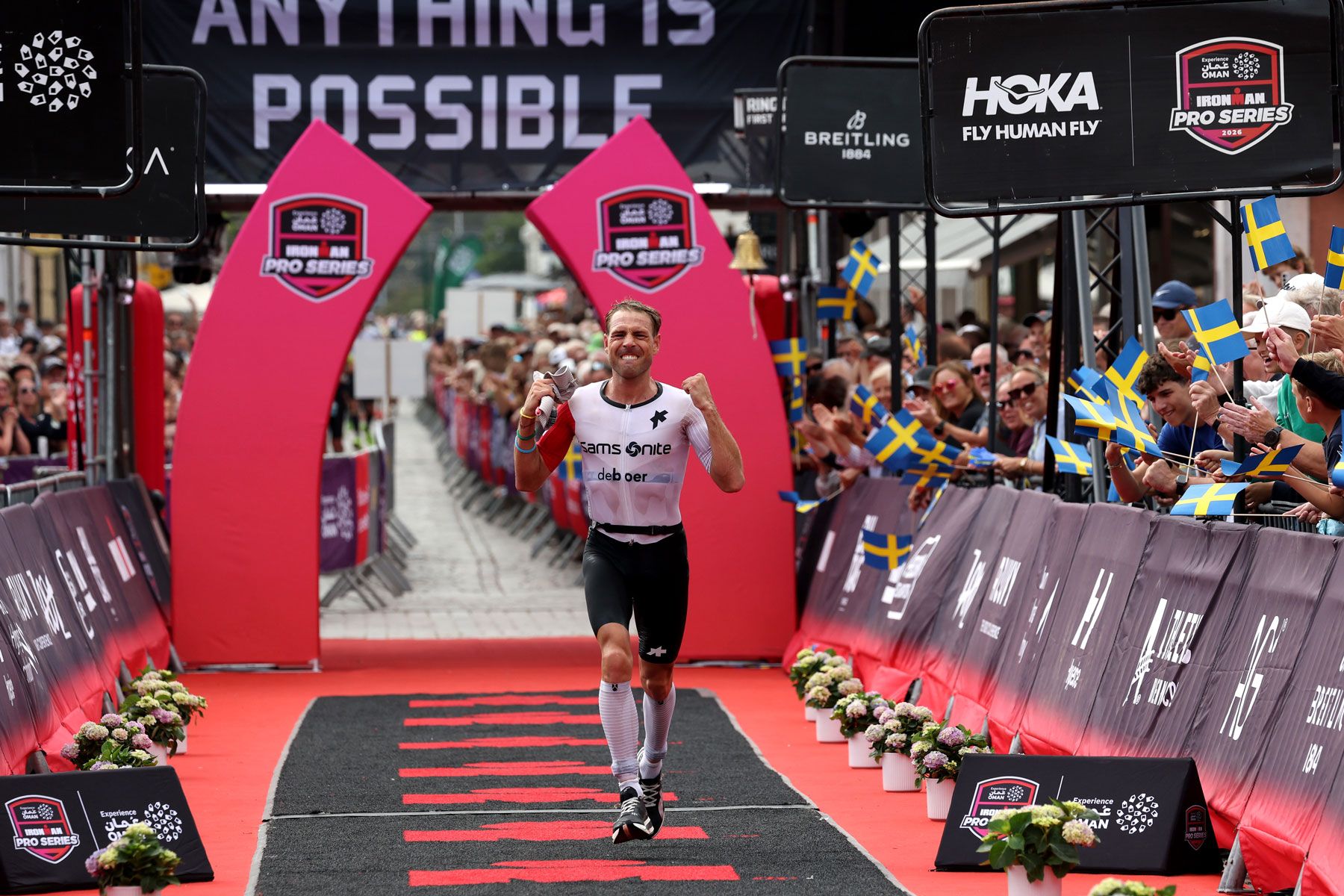
Andrea Salvisberg, two-time Olympian and European Championship bronze medalist in triathlon, set a new Swiss record at Ironman Kalmar with a time of 7:28:53 hours – eight minutes faster than the previous best by Ruedi Wild. After a severe meningitis in 2023, which sidelined the 37-year-old for eight months, and having recently become a father, this achievement crowns his comeback. The result in Kalmar secures him a starting place at the Ironman World Championship in Hawaii on October 10 – fulfilling his three major life goals: Olympics, Hawaii, fatherhood.
In my life, there were three milestones I wanted to achieve: Olympics, Hawaii, and becoming a father. That it worked out with Hawaii after all the setbacks makes me incredibly proud. The Ironman in Hawaii will be a big challenge due to the heat and high humidity. However, I now know how to supply myself with salt and carbohydrates under different conditions to avoid performance losses. If everything goes perfectly, my goal is a top-10 placement. But even a placement in the top 15 or top 20 would still be a success.
In August 2023, I was diagnosed with meningitis, which worsened due to an additional Covid-19 infection. For over eight months, severe fever came and went. Normal training was out of the question. Except for Samsonite, who equipped me with suitcases for my travels to triathlons around the world, all sponsors dropped out. That was an incredibly difficult time, and it would have been easy to end my career in this situation. However, I accepted the challenge and was rewarded three years later.
For middle and long-distance racing, nutrition is a make-or-break factor for me. It took me until this year, and several attempts in races over the past few seasons, to land on a fuelling strategy that actually works. I kept running into stomach problems that dragged my performance down, until I figured out that my body handles carbs best in liquid form. Testing also showed that I burn through a huge amount of carbs and lose a lot of fluid. Above 25 degrees, that means two litres on the bike and two and a half litres on the run. I now account for this by taking in 160 grams of carbs per hour, and I built up to that gradually over the past few months. On the run, I carry a hydration pack that holds two litres of fluid.

After my illness, I was looking for someone who could support me and who had real experience under their belt. I found that in Ben Reszel. Three years ago he was still pretty much unknown, but today he's in high demand and, alongside me, he coaches three-time Ironman world champion Patrick Lange and two-time Ironman 70.3 world champion Jelle Geens.
Train consistently and with discipline, but don't forget to enjoy life while you're at it.
For me, consistency is the single most important thing. If you keep at it, you improve almost by default. With the athletes I coach, though, I keep seeing fitness knocked back every time training gets interrupted.
My real strength is in the water. Through training I've become strong on the bike and on the run too. And now that nutrition is under control, I can genuinely call myself an all-rounder.

Compared to the very best, who put in 30 to 40 hours of training between Monday and Sunday, I simply don't train enough. My lifestyle, my role as a dad, and wanting a life outside of sports simply don't leave room for more.
In a normal week, I train around 25 to 30 hours; in a race week, 15 to 20 hours (including the race itself). My weeks usually look like this:
| Hours | Units |
Monday | 1-2 h | Active rest day with one hour of swimming and stability/mobility work |
Tuesday | 3-4 h | Track running session followed by an easy bike and swimming session |
Wednesday | 6-7 h | Intensive four-hour bike session, one-hour easy run, and one-hour swim |
Thursday |
| Dad day |
Friday | 4 h | Intensive two-and-a-half-hour run followed by a one-and-a-half-hour easy bike ride |
Saturday | 6-7 h | Intensive six-hour bike session and stability/mobility work |
Sunday | 6-7 h | Long bike ride and after a two to three-hour break a long run |
Total | 26 - 31 h |
To handle this kind of load, good nutrition before, during, and after each session matters, and so does proper recovery.
Fitness-wise, I feel like I'm in the shape of my life right now, but I no longer bounce back as quickly as I did a few years ago. On top of that, since our daughter was born ten months ago, my nights have been a bit shorter at times, though she gives me back so much energy that it evens out.
After a hard or long session I always have a protein shake, and I get regular massages. Furthermore, I stretch three to four times a week for 20 to 40 minutes to prevent any issue.
A high cadence is important in cycling so that you can still push while running. Typically, I aim for more than 90 rpm, both in training and in races.
I do strength training on the bike on climbs, running with hill repeats, and swimming with a pullbuoy and paddles. Additionally, I perform core stabilization exercises twice a week.

Train consistently to continuously improve your fitness.
Eat well before, during, and after training and racing. If you're on the road with enough carbohydrates, the training quality and recovery are much better.
To keep getting better, the joy of the sport has to be what drives you.
If you sweat a lot like I do, it's worth racing with a hydration vest. That way you can drink regularly and sufficiently and get plenty of carbs in at the same time.

Adrien Briffod, a 31-year-old former triathlete from Vevey, wants to try his luck at trail running in the future. He made his mark this year by coming fourth in the Sierre-Zinal race!

The 29 year-old Céline Aebi was the Swiss mountain running champion last year and has already represented Switzerland several times at international championships.

The key do's and don’ts to help your training efforts pay off.