Thu, October 23, 2025Jon Kistler in the Datasport-Check
@Maxime Schmid
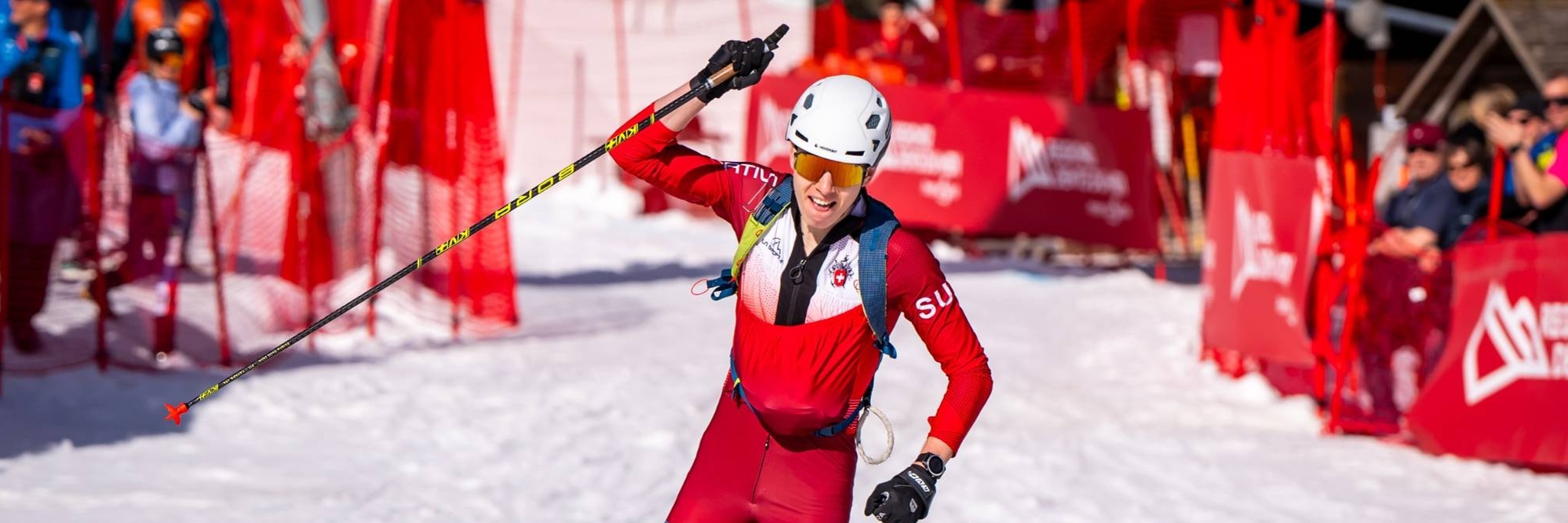
The 22-year-old Jon Kistler from Zurich wants to represent Switzerland in the newly added sport of ski mountaineering sprint at the Olympic Games in Milano Cortina.
Milano-Cortina
This winter, ski mountaineering will be part of the Olympic Games for the first time. The two Olympic disciplines, sprint and mixed relay, will take place in Bormio. Its inclusion in the Olympic programme is a milestone for my sport, and participating would be a dream come true for me.
Daily training routine
During summer training, I train on a racing bike, on foot or with roller skis. I also go to the gym at OYM twice a week. In winter, my training consists of a mixture of snow training in the Engadin and running training in Zurich. During the preparation phase and also during the season, I complete a large part of my intensive training sessions on the 400-metre track.
@Maxime Schmid
Training volume
I usually train between 10 and 20 hours per week.
OYM
Since 2024, I have been training at OYM as part of the OYM Intersport Academy. The expertise and infrastructure available at OYM have helped me make great steps forward, particularly in the area of strength training. Every two to three months, we complete a series of tests to see which areas require more attention. This allows us to plan our training optimally.
Coach
Since last season, I have been trained by Christoph Schmid. I am his first and so far only skimo athlete. Thanks to his many years of experience in sports such as athletics and cross-country skiing, it is a very exciting and successful collaboration.
@Maxime Schmid
Key to success
The key to my success is a good environment and the conviction that, together with this environment, I can get the best out of myself. To achieve this, it is important for me to focus fully on my main goal. In a sport that has traditionally been dominated by all-rounders, this meant specialising in sprinting in order to give myself the best possible chance of qualifying for the Olympics.
Equipment
Our equipment is primarily designed for climbing. To be as light as possible, the skis are only about 65 mm wide and 160 cm long. The boots are made of carbon and offer a great deal of freedom of movement. This freedom is the biggest difference to normal touring equipment, as it allows for greater and more natural movement in the ankle. However, both the skis and the boots have disadvantages when it comes to downhill skiing.
Lactate
The ascent in the sprint discipline takes just under two minutes and leads to extremely high lactate levels. The biggest challenge is to complete clean skin changes and a fast descent despite ‘blue legs’. Tactical decisions, such as positioning in the transition zone, also become more difficult as lactate levels rise.
Studies
In addition to sport, I am studying mechanical engineering part-time at ETH Zurich. Combining my studies and sport is a difficult but exciting challenge for me. I have taken a semester off to prepare for the Olympic Games in the best possible way.
@Maxime Schmid
Ski mountaineering vs. ski touring
The difference between ski mountaineering and ski touring lies primarily in the equipment and the ‘culture’. Ski mountaineering focuses on competitive sport, so the emphasis is on training. Ideally, this can be combined with a beautiful summit or a beautiful descent in powder snow. However, due to the conditions or specific training requirements, I often train on the slopes.
Flatlanders in mountain sports
I used to spend a lot of time in the mountains with my family. We did everything from skiing to mountaineering. Ski mountaineering combines these two sports and also involves training in other endurance sports such as cycling. That's exactly what fascinates me about this sport.
Strength
I can perform well when it matters. Once the race has started, I can focus very well and make very few mistakes.
Weakness
My biggest weakness is the descent. I have already lost a few places because of this.
Insider tip
To compete in ski mountaineering races as a competitive sport, it is not necessary to live in the mountains. Most of the physical training can also be done off-piste and then transferred to skiing in a few key sessions.
You might be interested in
Interviews
Janine Meyer in the Datasport check
Janine Meyer is the best of all amateur cyclists. She has already won more than 200 cycling races! At the beginning of September, the 47-year-old won the Ötztaler Cycle Marathon for the third time – and set a new course record in the process.
General tips
Stretch your muscles
When you hear the word ‘stretching’, you immediately think of a wide variety of methods – from dynamic rocking to static stretching. The world of stretching techniques is full of trends and opinions. But which method can actually permanently lengthen a shortened muscle?
General tips
3 mental exercises for a successful next season
Find your “why”, get playful during a monotonous session and think about the reward when you’re toughing it out. These are three simple tricks that don’t need any equipment, just a bit of focus.
.jpg)
.jpg)
.jpg)