Foto: iStock.com/PeopleImages
Almost everyone has favourite exercises that they enjoy doing and/or that are particularly effective. My favourite exercises offer a perfect combination of strength, endurance, dynamism, stability and good coordination.
For my top three, you simply need a mat, a kettlebell and a Swiss ball. As simple as this equipment may seem, the exercises themselves are demanding. Each one represents a real challenge and may not work perfectly at the first attempt. Precisely for this reason, they provide varied and highly effective training.
Why asymmetrical exercises?
I am a big fan of asymmetrical exercises. The reason: everyday life is dominated by one-sided movements – whether one-armed, cross-body or one-legged – while symmetrical, parallel movements occur far less frequently. In gym-based fitness training, however, asymmetry is often barely taken into account. Most strength machines mainly target symmetrical muscle groups, whereas free weights or training with your own body weiht allow a much stronger focus on asymmetrical loading.
1. Kettlebell swings with lunge
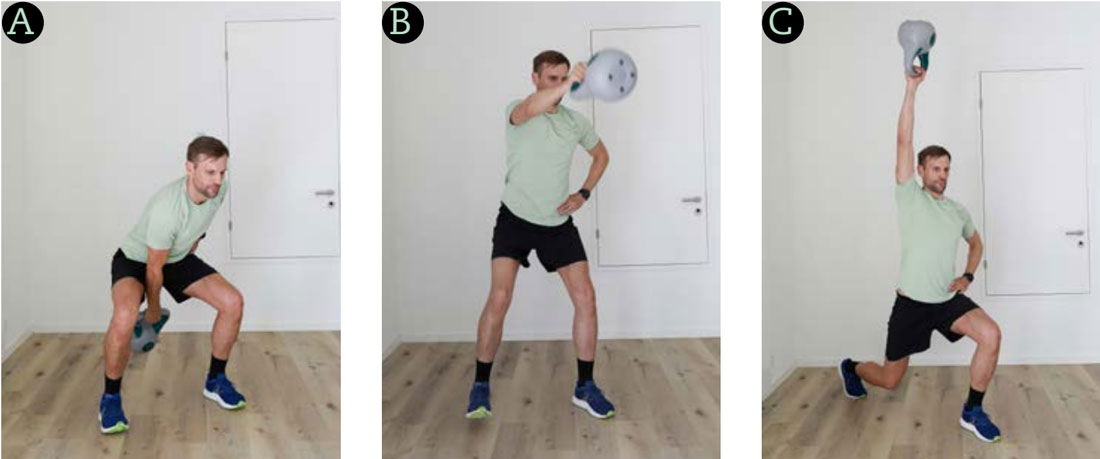
This first exercise combines symmetry and asymmetry in the leg work, while the upper body is loaded on one side only. This particularly strengthens the diagonally acting muscle systems of the core. The dynamic alternation in the leg action challenges the leg alignment, while the core must remain stable in order to optimally support the arm movement.
Objective: Strengthen the legs, stabilise the leg axes, improve core stability and strengthen the arms.
Here’s how:
- 2.Stand with feet hip-width apart, kettlebell in one hand, the other hand resting on the hip.
- 4.Bend the knees slightly and swing the kettlebell with a straight arm gently back between the legs (A).
- 6.Then extend the knees and straighten the upper body powerfully so that the kettlebell swings forwards and upwards (B).
- 8.Before the kettlebell reaches its highest point, step one leg (on the same side as the kettlebell arm) backwards into a deep lunge and stabilise with the front leg (C).
- 10.Swing the kettlebell back down and at the same time return to the wide squat position.
Take note:
- Choose a kettlebell weight that can be held stably overhead.
- Swing the kettlebell up using momentum; do not actively lift it.
- Keep your back straight.
Repetitions: 3 sets of 10–15 repetitions per side
2. Dead bug with Swiss ball
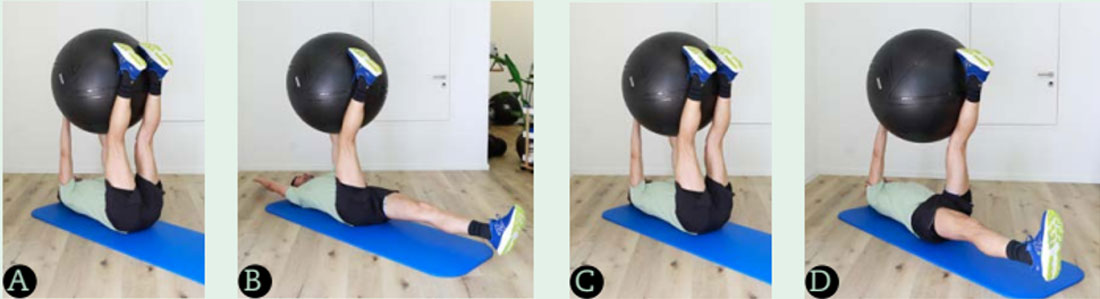
Many people train their abdominal muscles mainly with sit-ups or crunches. However, the oblique abdominal muscles are particularly important for core stability. As a cross-pattern mover, humans use a rotational movement between the legs and upper body with every step, which primarily activates the oblique abdominal muscles. With each movement, one diagonal structure contracts while the opposite one stabilises in a lengthened position – this interaction is especially central in the following exercise.
Objective: Strengthen the diagonal core muscles.
Here’s how:
- 2.Lie on your back on a mat, extend arms and legs straight upwards and hold a Swiss ball between them (A).
- 4.Now squeeze the ball between one arm and the opposite leg.
- 6.At the same time, slowly lower the other arm and the other leg towards the floor (B).
- 8.Pause briefly just before reaching the floor, then bring the arm and leg back to the ball (C).
- 10.Now lower the opposite diagonal towards the floor (D).
Take note:
- Squeeze the ball firmly; it should always remain elevated.
- Perform the movements slowly and in a controlled manner.
- Keep the lower back flat on the floor.
Repetitions: 2 sets of 15-20 repetitions
3. Side plank with diagonal crunch
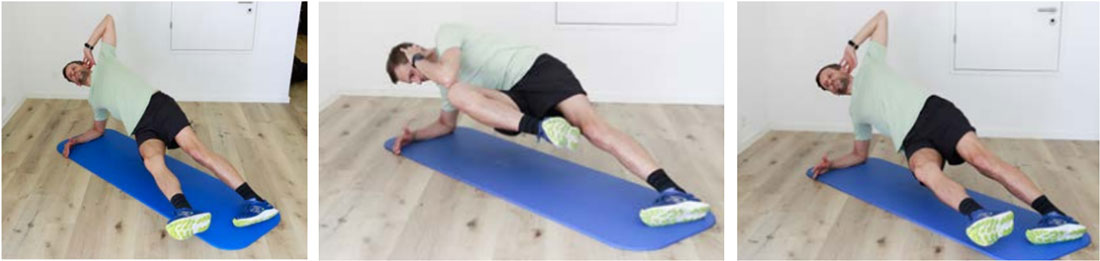
For many people, the side plank is a real challenge and is not always a favourite exercise. This is often due to a weak lateral force line that cannot stabilise the body sufficiently, or to a shoulder that is not fully stable. The side plank position is ideal as a starting exercise, and for many people the static hold alone is already challenging. By adding an extra dynamic component, the training can be intensified further – activating different force lines in the body and improving the interaction between stabilisation and movement.
Objective: Lengthen the chest muscles and activate lateral core strength.
Here’s how:
- 2.Take up a side plank position on your forearm. Support the upper leg on the floor, keep the lower leg slightly raised. Bend the upper arm and place the fingertips at the temple.
- 4.Now bend the knee of the lower leg and bring it towards the elbow of the upper arm until they touch.
- 6.After the diagonal crunch, return the leg to the starting position.
Take note:
- The body should form as straight a line as possible.
- In the side plank, the elbow should be positioned directly under the shoulder.
Repetitions: 2 sets of 10–15 repetitions per side