Anyone who wants to run fast and efficiently needs more than just endurance – the key lies in the calf muscles’ ability to store energy and release it again in a controlled way. This is precisely where eccentric training comes into play.
When running, the calf acts like a spring-loaded system: As the foot strikes the ground, the calf muscle lengthens because it has to control and decelerate the movement. This so-called eccentric muscle action is the prerequisite for the subsequent ‘snap-back effect’ – the movement responsible for a powerful push-off forwards. This mechanism is supported by the Achilles tendon, which acts like a tensioned spring as the strongest tendon in the body.
The load is particularly high at the transition point between eccentric (braking) and concentric (shortening) muscle action. This is precisely where the greatest forces occur within the muscle–tendon chain. It is therefore no surprise that many runners experience calf or Achilles tendon problems, particularly at the start of the running season when training intensity increases again.
The good news is that the elasticity of the calf at this transition point, as well as eccentric load capacity, can be improved through targeted training. The following exercises help strengthen the push-off phase so that the stored energy can be transferred more effectively during the snap-back.
Kneeling calf pulses
Here’s how:
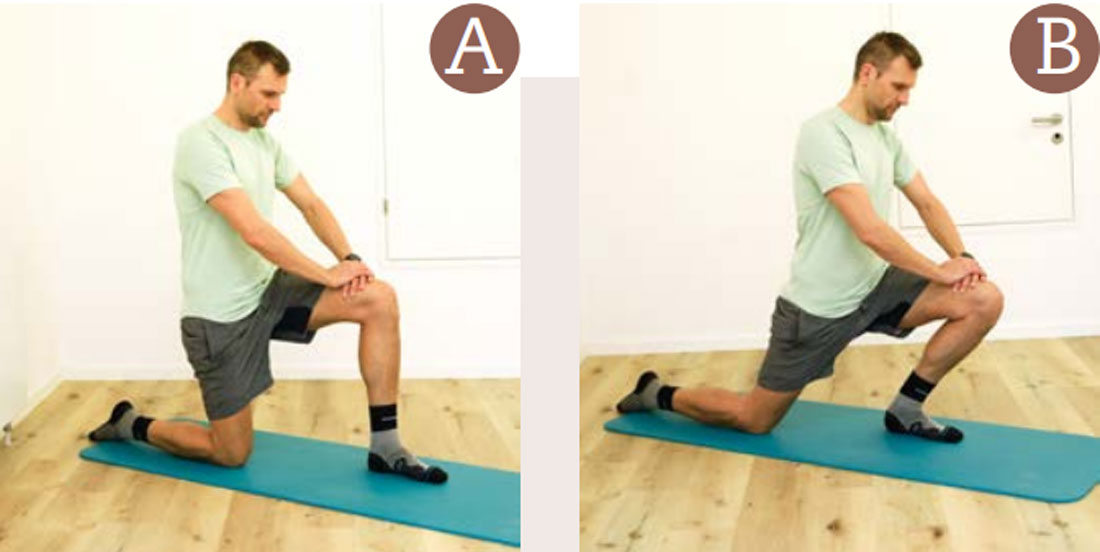
Kneel on a mat with one knee bent at around 90 degrees in front of you and the upper body upright. Support yourself by placing both hands on the front knee (A).
Now continuously push the knee forwards as far as possible (B).
The heel must remain on the floor at all times, including at the transition point, and must not lift off the ground.
In the end position (transition point), perform small bouncing movements by applying gentle pressure with the hands onto the knee.
Then push yourself back into the starting position (A).
Take note: Keep the heel fully in contact with the floor at all times.
Repetitions: 3 sets of 20 quick repetitions
Loaded calf stretch
Here’s how:
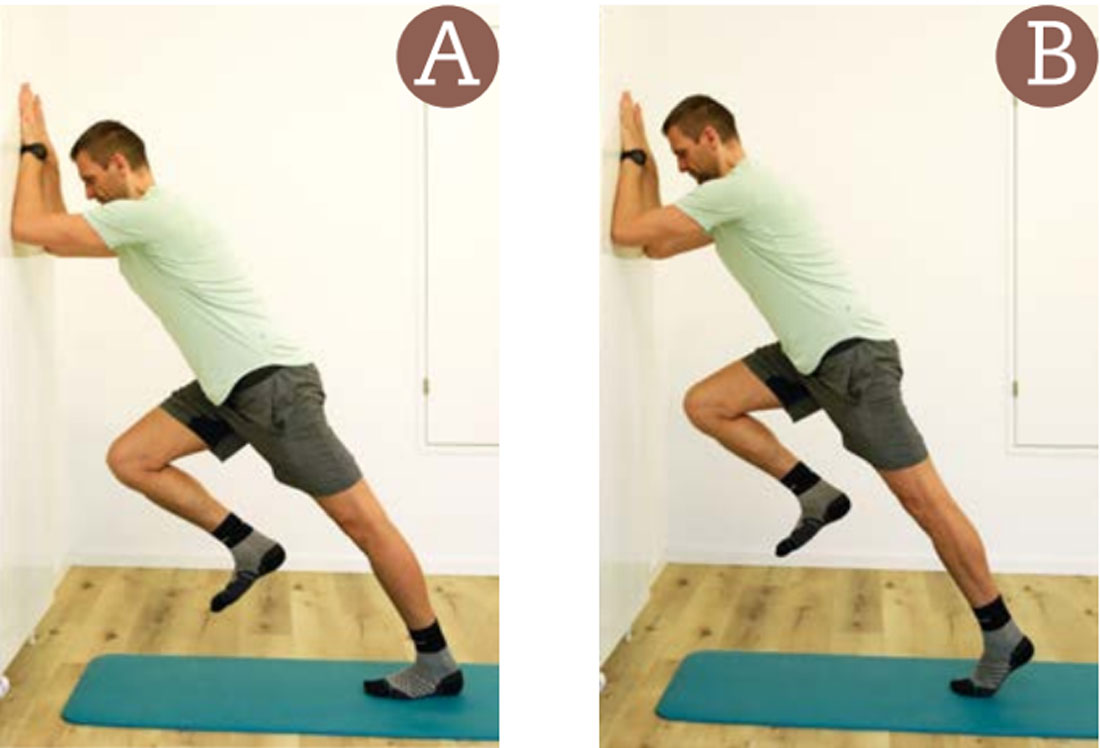
Stand around one metre away from a wall so that you feel a slight stretch in the rear calf while keeping the heel on the floor. Lean your forearms against the wall with the upper body straight and raise the front leg to approximately a right angle (A).
From this position, slowly push the foot of the supporting leg upwards through the ankle joint as high as possible onto the forefoot (B).
Then slowly lower the heel again until it almost – but not quite – touches the floor and the stretch can be felt again. Push the foot upwards again as far as possible and repeat the lowering movement.
Take note:
Keep the foot aligned throughout the movement.
The upward push and lowering movement should be slow and controlled.
Keep the upper body straight (no rounded back).
Maintain the bend in the front knee throughout the exercise.
Repetitions: 3 sets of 20 repetitions per side
Split stance and ‘snap-back’
Here’s how:
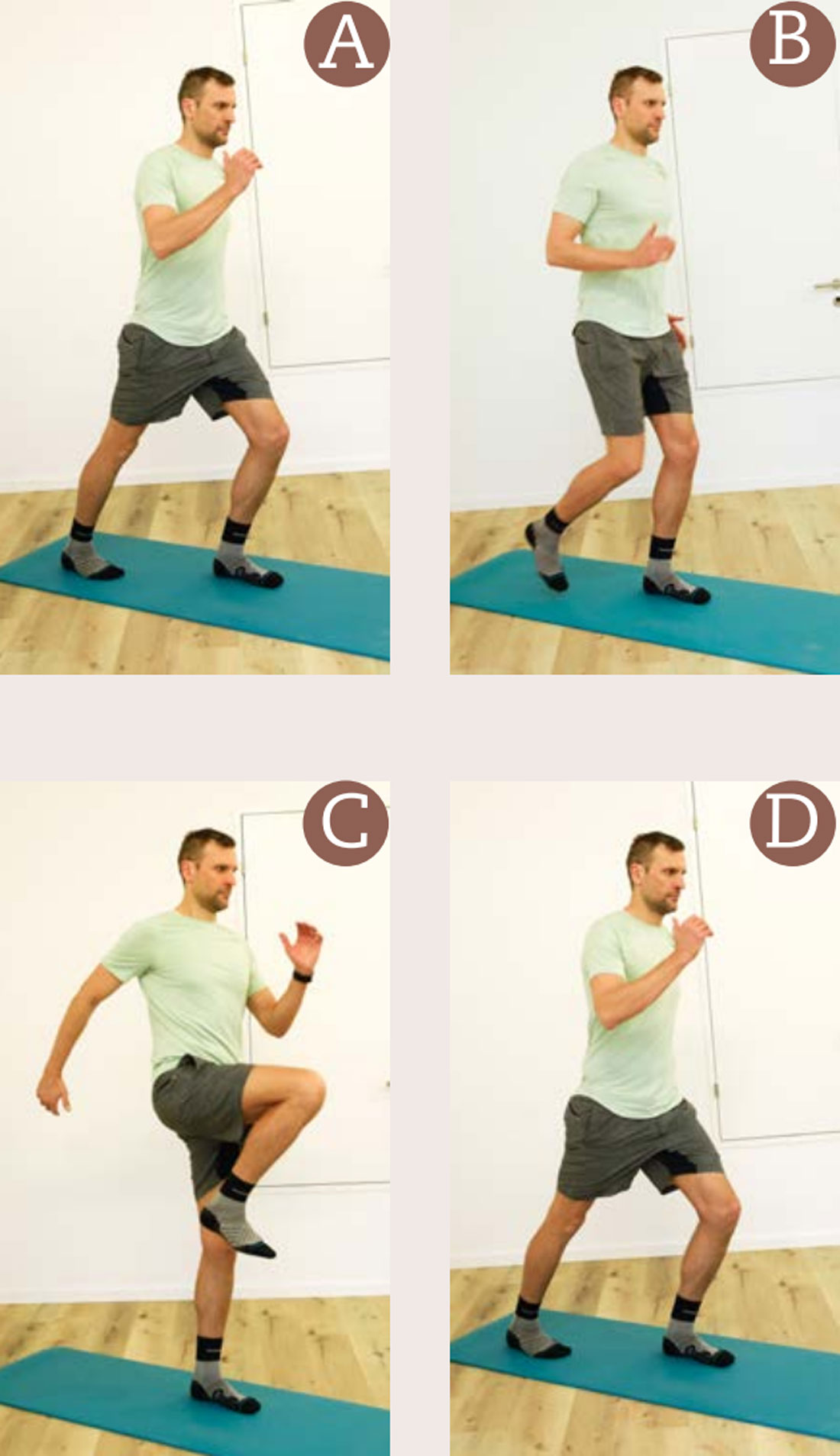
Stand in a split stance with the front leg slightly bent, the rear leg extended and the arms ready for the running motion (A).
Now push off dynamically with the rear leg and drive the knee forwards and upwards as far as possible (B/C).
Then return the leg backwards and roll the foot down until the heel is back on the floor (D).
As soon as the heel touches the ground again, explosively push off once more and drive the knee upwards again.
Take note:
Explosive push-off at the transition point of the foot.
Ensure the supporting leg remains properly aligned. Keep the upper body upright.
Start with a shorter split stance before gradually increasing the stride length.
Repetitions: 3 sets of 20 repetitions per side
You might be interested in
General tips
How to take care of your back
Back pain is part of everyday life for many people — including physically active individuals. However, pain does not automatically mean that something is damaged. In most cases, the cause is functional overload rather than structural injury.
Training tips
More strength in your legs
Um die Geschwindigkeit gegen die Schwerkraft zu halten, ist ein ausdauernder und kraftvoller Streckapparat unverzichtbar. Wir zeigen dir drei unverzichtbare Übungen.
Interviews
Jerome Furer in the Datasport Check
After several strong performances in road races, the 28-year-old became Swiss champion in trail running in mid-April and will represent Switzerland for the first time at the European Off-Road Running Championships in Slovenia this June.
Tue, May 5, 20263 exercises for powerful calves
Roman Knights
Foto: ZKB Zürilauf Cup
Anyone who wants to run fast and efficiently needs more than just endurance – the key lies in the calf muscles’ ability to store energy and release it again in a controlled way. This is precisely where eccentric training comes into play.
When running, the calf acts like a spring-loaded system: As the foot strikes the ground, the calf muscle lengthens because it has to control and decelerate the movement. This so-called eccentric muscle action is the prerequisite for the subsequent ‘snap-back effect’ – the movement responsible for a powerful push-off forwards. This mechanism is supported by the Achilles tendon, which acts like a tensioned spring as the strongest tendon in the body.
The load is particularly high at the transition point between eccentric (braking) and concentric (shortening) muscle action. This is precisely where the greatest forces occur within the muscle–tendon chain. It is therefore no surprise that many runners experience calf or Achilles tendon problems, particularly at the start of the running season when training intensity increases again.
The good news is that the elasticity of the calf at this transition point, as well as eccentric load capacity, can be improved through targeted training. The following exercises help strengthen the push-off phase so that the stored energy can be transferred more effectively during the snap-back.
Kneeling calf pulses
Here’s how:
Kneel on a mat with one knee bent at around 90 degrees in front of you and the upper body upright. Support yourself by placing both hands on the front knee (A).
Now continuously push the knee forwards as far as possible (B).
The heel must remain on the floor at all times, including at the transition point, and must not lift off the ground.
In the end position (transition point), perform small bouncing movements by applying gentle pressure with the hands onto the knee.
Then push yourself back into the starting position (A).
Take note: Keep the heel fully in contact with the floor at all times.
Repetitions: 3 sets of 20 quick repetitions
Loaded calf stretch
Here’s how:
Stand around one metre away from a wall so that you feel a slight stretch in the rear calf while keeping the heel on the floor. Lean your forearms against the wall with the upper body straight and raise the front leg to approximately a right angle (A).
From this position, slowly push the foot of the supporting leg upwards through the ankle joint as high as possible onto the forefoot (B).
Then slowly lower the heel again until it almost – but not quite – touches the floor and the stretch can be felt again. Push the foot upwards again as far as possible and repeat the lowering movement.
Take note:
Keep the foot aligned throughout the movement.
The upward push and lowering movement should be slow and controlled.
Keep the upper body straight (no rounded back).
Maintain the bend in the front knee throughout the exercise.
Repetitions: 3 sets of 20 repetitions per side
Split stance and ‘snap-back’
Here’s how:
Stand in a split stance with the front leg slightly bent, the rear leg extended and the arms ready for the running motion (A).
Now push off dynamically with the rear leg and drive the knee forwards and upwards as far as possible (B/C).
Then return the leg backwards and roll the foot down until the heel is back on the floor (D).
As soon as the heel touches the ground again, explosively push off once more and drive the knee upwards again.
Take note:
Explosive push-off at the transition point of the foot.
Ensure the supporting leg remains properly aligned. Keep the upper body upright.
Start with a shorter split stance before gradually increasing the stride length.
Repetitions: 3 sets of 20 repetitions per side
You might be interested in
General tips
How to take care of your back
Back pain is part of everyday life for many people — including physically active individuals. However, pain does not automatically mean that something is damaged. In most cases, the cause is functional overload rather than structural injury.
Training tips
More strength in your legs
Um die Geschwindigkeit gegen die Schwerkraft zu halten, ist ein ausdauernder und kraftvoller Streckapparat unverzichtbar. Wir zeigen dir drei unverzichtbare Übungen.
Interviews
Jerome Furer in the Datasport Check
After several strong performances in road races, the 28-year-old became Swiss champion in trail running in mid-April and will represent Switzerland for the first time at the European Off-Road Running Championships in Slovenia this June.