Wed, June 5, 2024The importance of sacroiliac joints
Foto: iStock.com/Prostock-Studio
This power transmission unit in your pelvis is kept busy.
The left and right sacroiliac joints (SIs) are located between your lower spine and pelvis. The SI joints sit in between your tailbone and the top of your pelvis. These joints only move 1-3 degrees and their surface is quite rough, ensuring excellent stability. So your pelvic halves move very slightly at the back of your SI joints and at the front of your pubic bone. These small movements are required to position your pelvis in a way that guarantees a good connection between your pelvis and your tailbone. This allows the power from your legs to be optimally transferred to your upper body and vice versa. In addition, the SI joints are stabilised by strong ligaments and powerful muscles.
Important pelvic position
Your pelvic position is crucial for optimum power transmission. The more your pelvis is ‘lifted’ on your supporting leg when walking and jogging, the better the power transmission from your upper body to your leg. Your strong ligament structure strains, thereby protecting your lower spine against excessive load. If your pelvis sinks too far on your free leg (‘hip drop’), you experience significant compression forces in your lower spine while using your supporting leg. To prevent this, you need to flex the outer hip muscles (gluteus medius and minimus) on your supporting leg side, as well as your abdominal muscles and groin on your free leg side. The better your pelvis is positioned on your thighbone on your standing leg side, the more stable your leg axis becomes and the less strain is placed on your lower spine. This allows your SI joints to optimally perform their role as a power transmission unit.
What should you do if you experience pain?
Muscular tension and excess pressure in your lower spine can be painful. Tense muscles hurt and primarily require gentle exercise. This improves your circulation and relieves the pain. The same applies to excess pressure in your joints. Changing position is good for your spine and helps you relax. Three exercises for your SI joints.
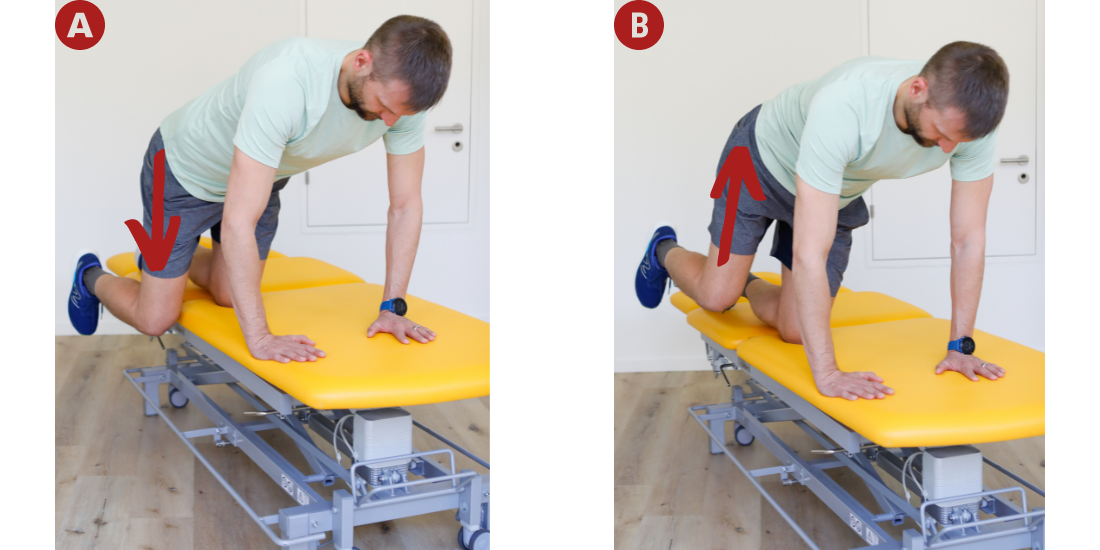
Lowering your leg on all fours
Here’s how:
Position yourself on all fours on your bed or sofa so that one knee is in the air.
Keep your back and neck straight.
Now lower your free knee, while keeping the rest of your body still (1A).
Then lift your leg back up again.
Take note: slow, controlled movements are important here. Move from your hips, pelvis and lower spine. Perform this exercise for as long as you can without causing any pain.
Frequency: 2 sets of 20 repetitions.
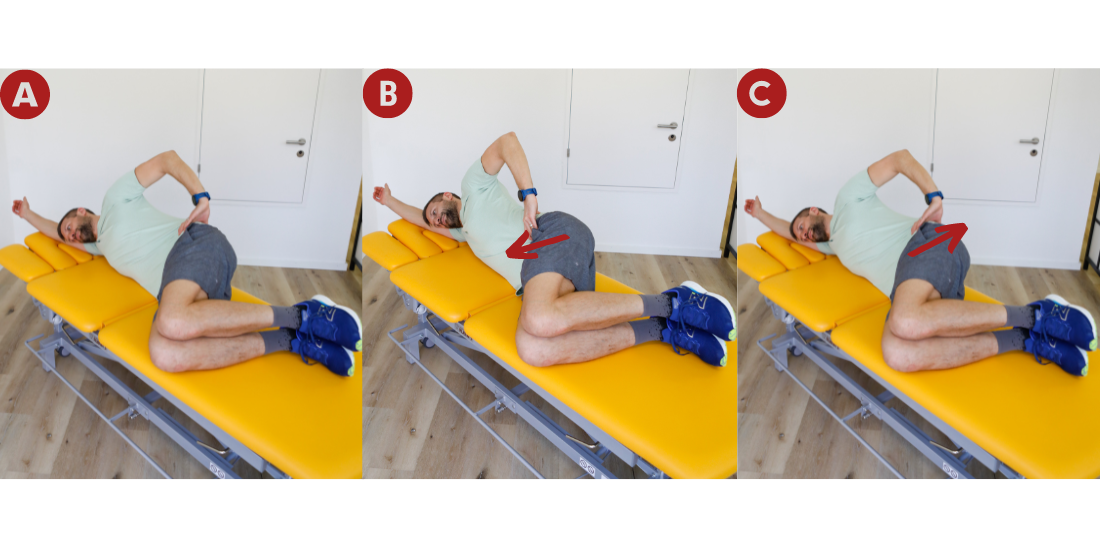
Exercising your pelvis lying on your side
Here’s how:
Lie on your side on a mat with your knees pulled up.
Place your hand on your pelvic bone in order to better control the movement (2A).
Now lift your pelvis forwards, forming a hollow back (2B).
Then drop your pelvis back again (2C).
Take note: this exercise requires coordination. It’s essential to switch between tensing your spine to lift your pelvis and tensing your abdomen to lower it again. Your pelvis ultimately moves in a diagonal line from top to bottom. This exercise should also be painless.
Frequency: 2 sets of 20 repetitions.
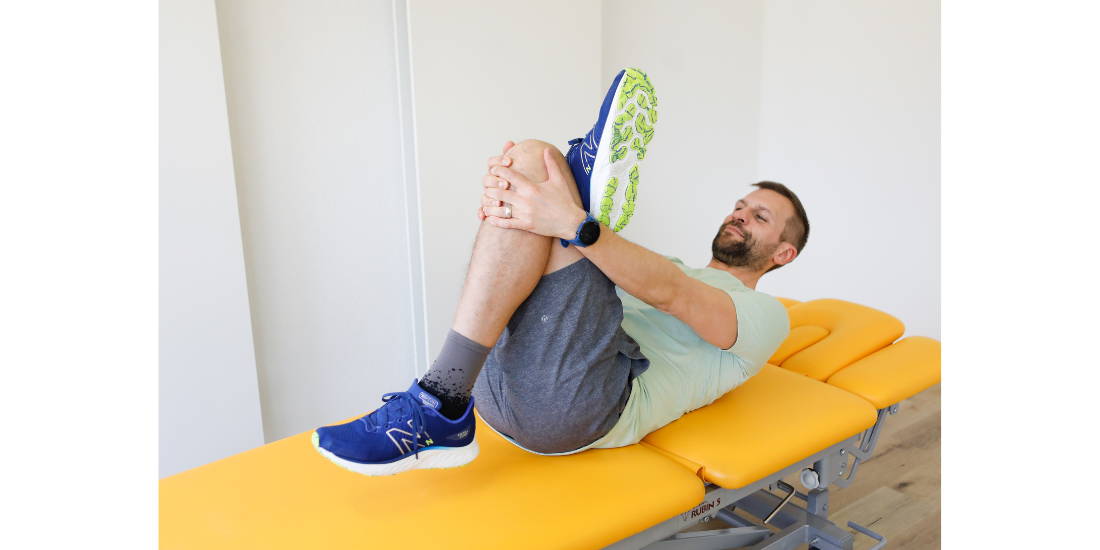
Exercising your deep gluteal muscles
Here’s how:
Lie on your back and raise both legs. Now cross one leg over the other.
Using both hands, grasp your raised leg and pull it as close to your chest as possible.
When crossing your leg, you should feel your deep gluteal muscles stretch.
Change sides.
Take note: there should be tolerable tension in your gluteal muscles. If your leg begins to tingle or your foot becomes numb, reduce the stretching. This stretching exercise can also be performed while sitting. Simply cross one leg over the other and then drop your knee to the side. Keep your upper body upright.
Frequency: 2 sets of 60-90 seconds per side.
You might be interested in
Diet tips
What should you eat before exercising?
There is a difference between a generally healthy diet and specific nutrition prior to physical exercise. What is the ideal nutrition before a tough or easy training session at lunchtime or in the evening?
Training tips
How to avoid over-training
Motivated not so long ago - and now completely exhausted? We explain how to maintain your performance and stay healthy even with a busy training schedule, as well as how to avoid under-recovery.
Training tips
Performance boost with hills
We often forget that to get faster and achieve new personal bests, we should also run regularly on hilly terrain as well as flat surfaces.