Sat, March 28, 2026Which training model will take you to the top?
Dea Sikiric
Foto: Canva/Sabina Iliescu
Anyone preparing for a sporting goal can distribute their training time across different intensity zones in various ways. We explain which models exist and which approach makes sense for whom.
Even in recreational sport, modern endurance training is no longer based purely on feel. Training models structure how training load is distributed across intensity levels. In sports science, this is referred to as training intensity distribution (TID) – in other words, how training time is allocated across different intensity zones in order to apply training stimuli as efficiently as possible. Three models are discussed particularly frequently: the pyramidal model, the threshold training model and the polarised model.
Macro, meso and microcycles are used to describe the time structure of training planning. A macrocycle usually covers an entire season, a mesocycle several training weeks and a microcycle often one training week. The training models described here define how training intensities are distributed within these cycles.
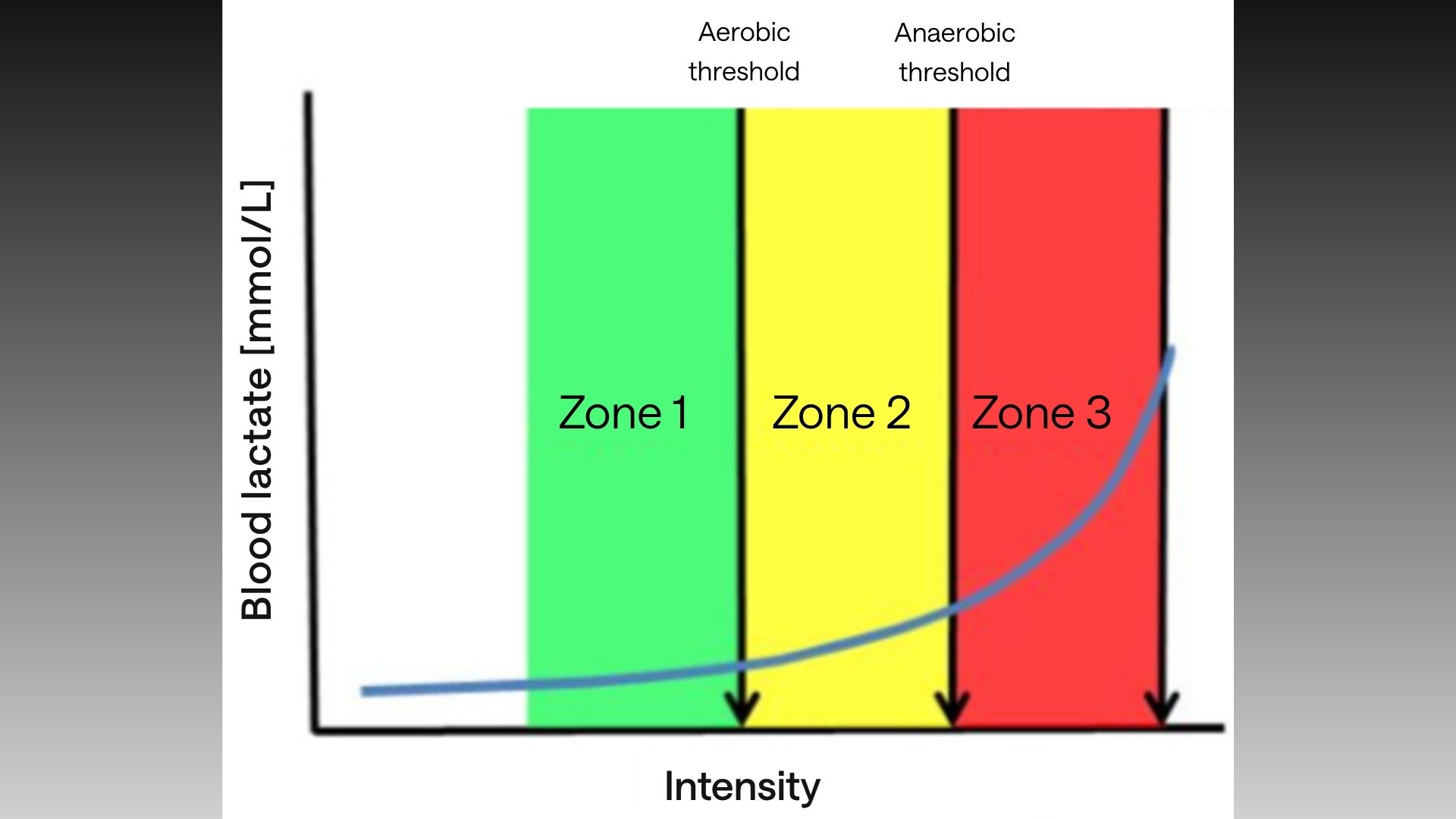
Physiological thresholds are often used to define intensity zones, particularly the first and second lactate thresholds (LT1 and LT2). LT1 marks the point at which the lactate concentration in the blood begins to rise for the first time. Below this intensity, aerobic metabolism dominates and exercise can be sustained for long periods. LT2 describes the range in which lactate is produced faster than it can be removed, meaning exercise duration becomes clearly limited. Important: In this model, LT2 is not the same as the currently popular ‘Zone 2’, but represents a significantly higher intensity!
On this basis, many studies use a three-zone intensity model. Zone 1 includes low intensities below LT1 and corresponds to easy aerobic base training. Zone 2 lies between LT1 and LT2 and includes moderate to demanding tempo or threshold training. Zone 3 describes intensities above LT2 and includes high-intensity efforts such as VO₂max intervals. The training models differ mainly in how much time is spent in each zone.
The polarised training model
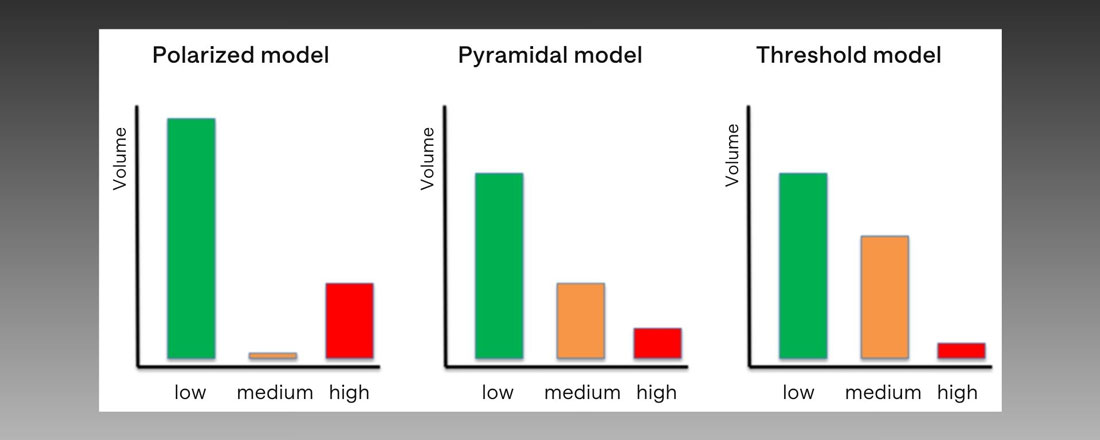
In polarised training, the majority of training is completed at very low intensity, while a smaller portion is performed at very high intensity. Moderate intensities are largely avoided. Typically, around 75–80% of training time is spent below LT1 and roughly 15–20% above LT2. Many easy sessions improve the aerobic base and recovery capacity, while intense intervals provide strong performance stimuli. Typical sessions include long steady endurance runs as well as intense intervals or hill repetitions. This model became particularly well known through research by Norwegian sports scientist Stephen Seiler, who analysed training data from elite athletes. His studies showed that successful athletes often follow a polarised intensity distribution.
Advantages:
Development of a strong aerobic base
Lower risk of overtraining
Improvement in speed capacity
Disadvantages:
High time investment for the large volume of base training
Mental toughness required for intense sessions
Less variety due to limited training at moderate intensity
The pyramidal training model
The pyramidal model is similar to polarised training but includes more work at moderate intensities. Typically, 70–75% of training time is below LT1, 15–20% is between LT1 and LT2 and 5–10% is above LT2. This creates a pyramid-shaped distribution: plenty of easy training, some moderate to demanding training and only a small amount of very intense training. This model is often used by athletes competing in events lasting 25 minutes to three hours.
Advantages:
Effective combination of different intensity zones
Targeted preparation for competitions
Greater variety through diverse training content
Disadvantages:
Increased injury risk if moderate intensity volume becomes too high
More recovery time required
Training control can be more complex
The threshold training model
In the threshold training model, the focus lies on efforts around LT2. A large portion of training takes place at moderate to demanding intensities between LT1 and LT2, while very easy or very intense sessions play a smaller role. Typical sessions include tempo runs, longer threshold intervals or race-specific efforts. This approach became particularly popular through the so-called Norwegian training model in triathlon, cross-country skiing and athletics. The goal is to improve performance specifically at threshold intensity, as this is closely linked to endurance race performance.
Advantages:
Rapid performance improvements
Reduced total training time required
Improved fatigue resistance at race pace
Disadvantages:
Higher risk of overload
Longer recovery periods needed
Neglecting the aerobic base may weaken capillarisation and fat metabolism
What does the research say?
Studies have repeatedly examined the effectiveness of different intensity distributions. In a frequently cited study, Thomas Stöggl and Billy Sperlich compared different training models and concluded that polarised training led to particularly large improvements in VO₂max, time to exhaustion and running performance in well-trained athletes. Observational studies also show that successful elite athletes often follow either a pyramidal or polarised intensity distribution.
Which model is right for whom?
The most suitable model depends on training level, sport discipline, race duration and available training time. Beginners and many recreational athletes often benefit from a pyramidal structure, where many easy sessions steadily build aerobic capacity while varied training provides motivation and balance. More advanced athletes can benefit more strongly from polarised training, as high-intensity sessions provide targeted performance stimuli. Athletes with limited training time sometimes integrate more threshold training in order to achieve specific adaptations efficiently.
However, successful athletes rarely train permanently according to just one model. Intensity distribution often changes over the course of the season: Base phases are usually more pyramidal in structure, while more intensive training blocks or race preparation phases increasingly incorporate polarised structures or targeted threshold blocks, depending on the goal distance. Training models are therefore not rigid systems, but rather serve as guidance within a structured and periodised training plan.
You might be interested in
Training tips
The magic of zone 2
‘Zone 2 training’ has been one of the biggest buzzwords in endurance sport over the past year. It is even said to have helped Tadej Pogačar further improve his already exceptional performance. Find out how it can make you faster too.
Diet tips
Sugar in sport: curse and blessing
While some athletes avoid carbohydrates during exercise out of fear of insulin resistance, others try to consume more than 120 grams per hour. Find out which approaches influence performance and what scientific research has to say.
Interviews
Pascal Rüeger in the Datasport Check
As part of the Italian long-distance championships, Pascal Rüeger broke one of Switzerland’s longest-standing athletics records. The 45-year-old runner from Aargau won the 100 km race south-east of Rimini in 6:18:27, smashing the national record from 1985 by 8 minutes and 57 seconds.