Interviews
Interview with Jonas Baumann
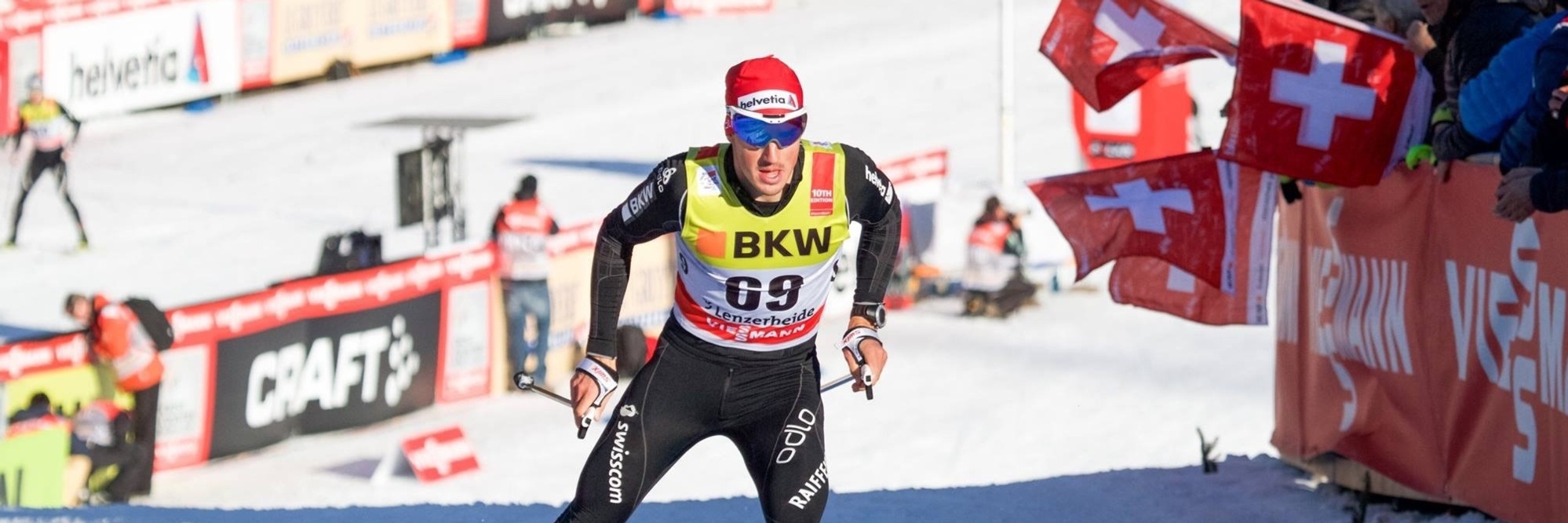
Periodically we publish an interview with an interesting sports personality. Today with Jonas Baumann, Swiss x-country skier and Swiss champion in the 15 km freestyle (2015).
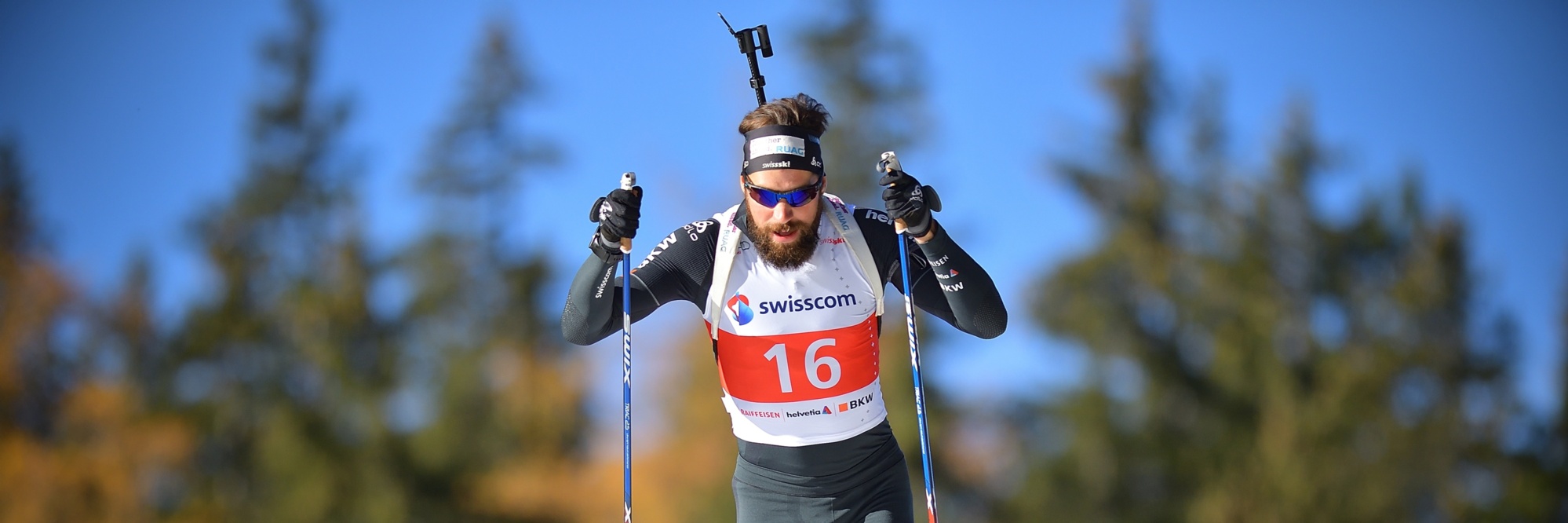
For 9 years, Benjamin Weger has been running in the World Cup, regularly achieving top ten results. On a good day, the Upper Valais athlete has the potential beat the world’s best.
You have been participating in the World Cup for several years now. In your eyes, what are the key factors that you have brought so far, on the one hand, and led to your success, on the other?
As soon as I finished my compulsory schooling, I focused completely on sports. This commitment to the sport and everything that goes with it is necessary to get completely ahead. And yet: it is also no guarantee that you will really make it. Even if the biathlon was actually quite easy, it takes much more than skiing fast and shooting well.
What does the everyday training of a biathlete look like? Can you give us an overview of how much time you spend on cross-country skis, at the shooting range, lifting weights, and how much you invest in agility and recovery?
My daily routine is relatively monotonous and consists of training, eating, and sleeping. Two units a day amounts to around 750 hours of training per year. On top of this, I shoot 13,000 -15,000 shots.
We start training in May. The shooting and endurance training is done separately. The focus is on developing a basic feeling so you can perform under pressure. As the training progresses, we gradually combine shooting with the increasingly more intensive endurance training so it not only becomes second nature by the start of the season, but the holding capacity, for example, is optimized to the point that when you fire a shot, you have a quarter to half a second and not just a tenth of a second.
Shooting in the standing position is reactive shooting. This has nothing to do with the normal shooting sport. Shooting lying down is a kind of precision shooting, whereby the disc is significantly smaller.
At a biathlon, you need to shoot with a high heart rate under pressure. Can you explain to us how you prepare the shooting (the last metres before the shooting range), what goes through your mind, and how you manage to keep a steady hand when your pulse is racing and you are breathing rapidly?
There is no ONE recipe. Every shooting range and run-up distance is different. Sometimes you approach the shooting range on a descent, sometimes on an ascent. In principle, I attempt to reduce my speed and consciously breathe deeply, so my oxygen saturation is sufficient. Then I observe the wind to see if it has changed as I zero in for the shoot. I then make my way to vicinity of the shooting mat, take a look at the flag again, remove the gun from my back and insert the magazine.
During this process, I always try to take deep, deliberate breaths. I then focus on myself and my target, the black dot. I am so focused on myself, I am no longer aware of my surroundings. I like to concentrate on technical aspects, such as the trigger, as this banishes any distracting thoughts, such as "what happens if I miss".
Shooting is basically purely a matter of self-confidence. It is something you acquire throughout the entire preparation and not in the seconds before the shoot.
A biathlon is a large crowd puller in many countries. In your eyes, what is appealing about this type of sport?
Spectators find the whole affair simply great. Each biathlon is a huge festival for thousands of people having a great time. It remains exciting right up until the last moment, because you’re never sure who is going to win.
For me as an athlete, the appeal lies in the combination of very different sports: whereas calm and concentration is needed during the shoot, you virtually experience the complete opposite when cross-country skiing. I find it fascinating how these two types of sports can be combined, which makes it a path worth taking.
Periodically we publish an interview with an interesting sports personality. Today with Jonas Baumann, Swiss x-country skier and Swiss champion in the 15 km freestyle (2015).

While it’s not that far off, it is still quite possible that, as a lowlander, you will need to get by until Christmas without any snow at all. However, there are enough good training alternatives with which cross-country skiers can prepare for the winter.
