
Training tips
How long you should recover for after a race
After a race, your body needs time to recover. How long this takes depends on the race distance, your fitness level and your age. We explain how much time you should set aside and why.

Do you often struggle to choose the right pace for your races? That’s perfectly normal, since race pace is never the same for every event: it depends on a variety of factors.
‘Flat out’ might be what comes to mind when you think about race pace. That may be true if your race is 100 metres long. However, in races beyond 200 metres you need to balance speed with control right from the start. In a much longer race, such as a half marathon or marathon, you are running at a pace that is no longer comparable to a 100-metre sprint. If you go ‘flat out’ from the start, you'll be forced to stop after 100 metres – even though the race still has several minutes or even hours to go.
This example shows that race pace depends on the distance or duration. The longer the race, the slower your pace will be. This can be mentally challenging, especially at the beginning of a longer event, because you may feel capable of running much faster and have to hold yourself back to avoid setting off too fast.
The better your fitness level, the higher the intensity you can sustain – and for longer periods. That is exactly what training is designed to optimise: you should aim to run at the highest possible intensity for as long as possible.
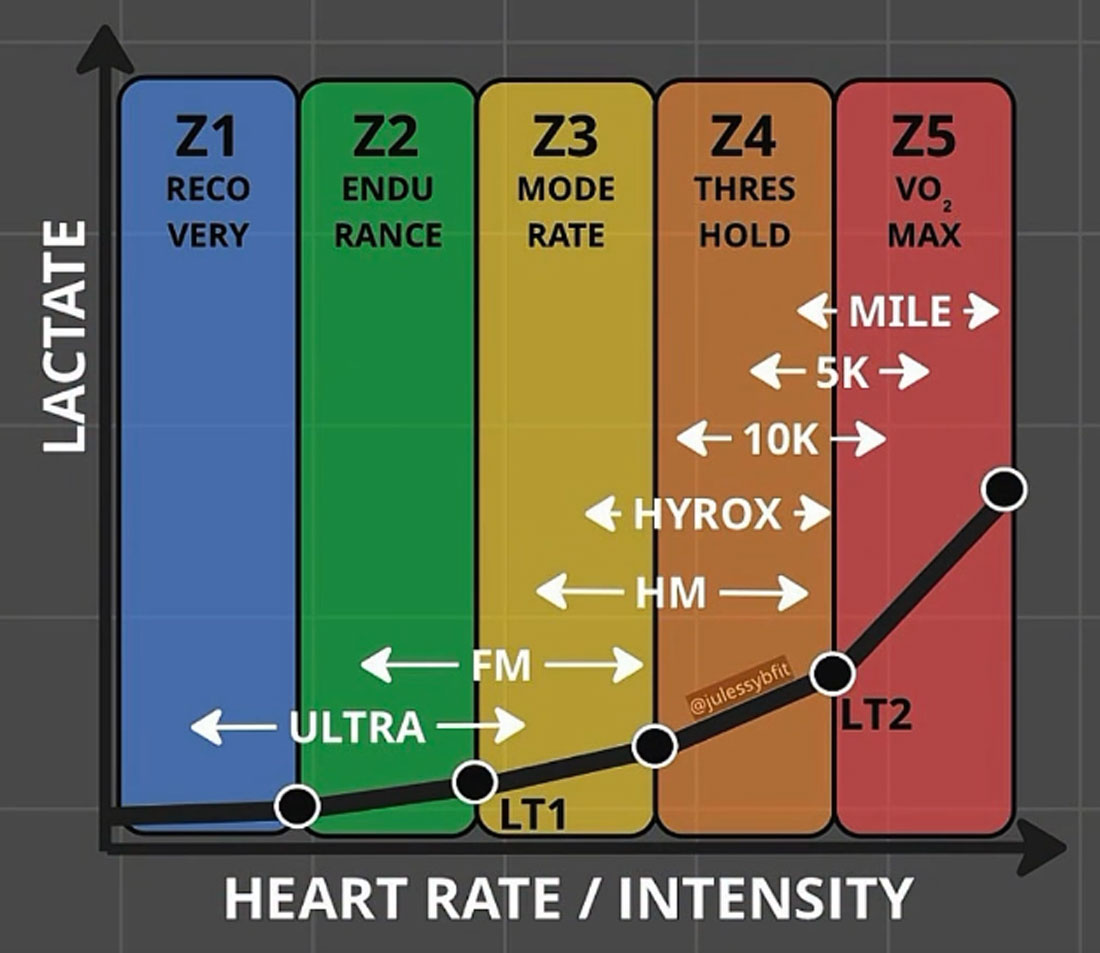
So, how do you achieve this? First of all, it’s important to understand that simply spending as much time as possible at race pace is not the most effective approach. Every race distance requires a balance between aerobic capacity (your endurance base) and speed (faster training sessions). The shorter the race distance, the more important speed becomes – and vice versa. Nevertheless, endurance underpins everything.
After a race, your body needs time to recover. How long this takes depends on the race distance, your fitness level and your age. We explain how much time you should set aside and why.

Anyone who wants to run fast and efficiently needs more than just endurance – the key lies in the calf muscles’ ability to store energy and release it again in a controlled way. This is precisely where eccentric training comes into play.

After the recent spell of cold and wet weather, we’re now heading into a period of high temperatures. That can become quite challenging if you want to continue your training as usual or even take part in a race. We’ll show you what to look out for and share some effective strategies to stay cool.