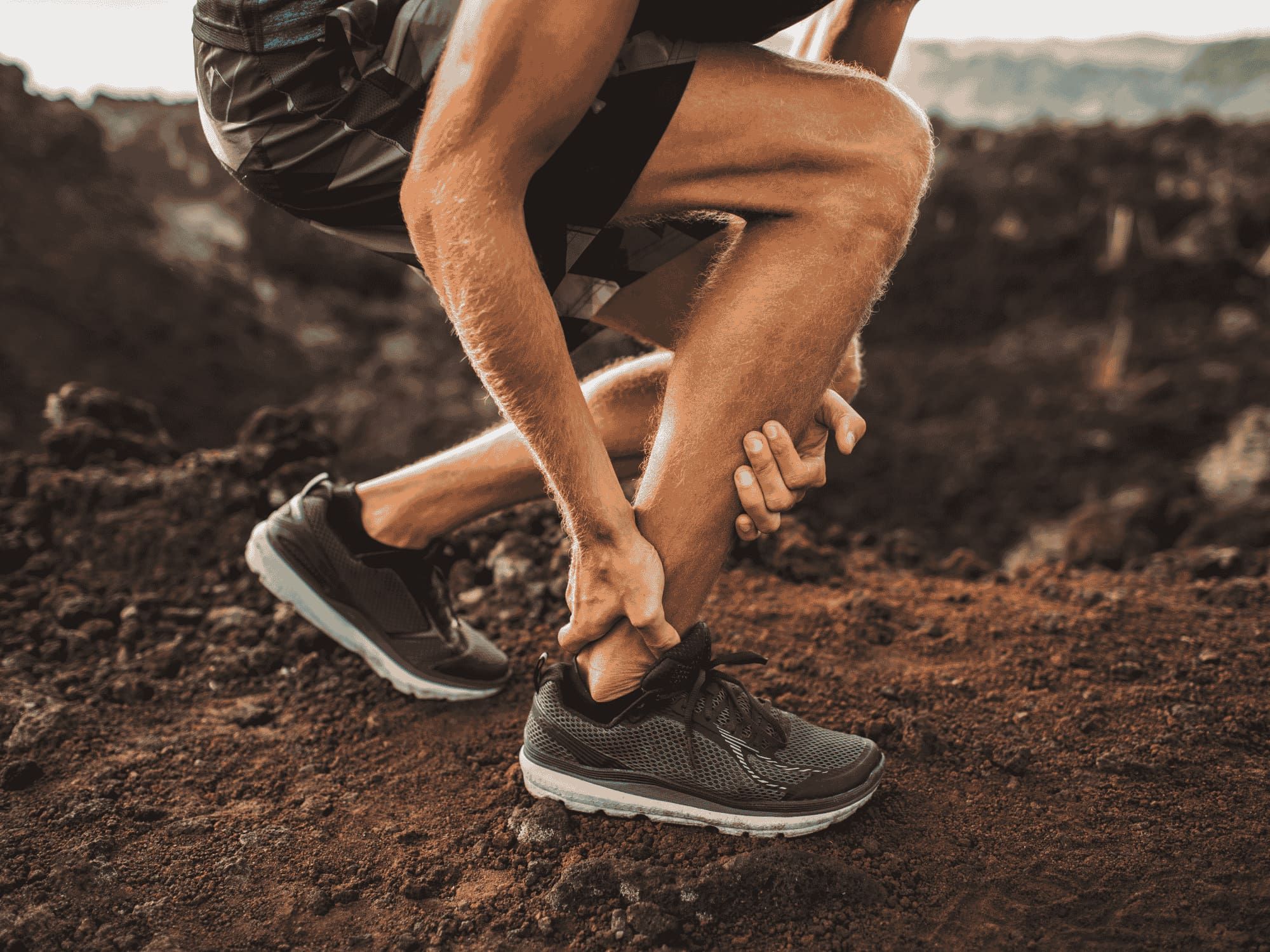
Many runners will be familiar with the problem: the Achilles tendon hurts, feels tender under load or starts to make itself felt after training. This can be a persistent issue, as tendons have a relatively poor blood supply and heal slowly. Patience is essential – along with the right training.
The key approach to tendon rehabilitation is Heavy Slow Resistance – slow strength training using high, controlled resistance.
A stable foot position is essential
Before specifically loading and strengthening the Achilles tendon, it is worth looking at foot stability. If the heel rolls inwards or outwards, this can place additional strain on the Achilles tendon. What may go largely unnoticed in the short term can develop into a problem over many steps and weeks. A stable foot position is therefore an important part of loading the tendon efficiently and avoiding unnecessary spikes in stress.
The strongest tendon in the Body
The Achilles tendon is the strongest tendon in the human body. It transfers the pulling forces generated by the calf muscles to the heel bone, playing a central role in almost every movement of the foot.
The calf muscles consist primarily of two large muscles: the gastrocnemius and the soleus. Both attach to the heel bone via the Achilles tendon. Along its length, the fibres of the Achilles tendon are partially twisted around one another. This complex structure helps the tendon withstand enormous forces and transmit them efficiently.
The heel bone acts as a biomechanical lever, allowing the force generated by the calf muscles to be transferred efficiently to the foot. Depending on the activity, the forces acting on the Achilles tendon can reach several times our body weight: around three times body weight when walking, approximately four to eight times when jogging, and up to ten times when sprinting or jumping.
A healthy Achilles tendon is well equipped to cope with these demands. However, if it has already been damaged or is overloaded, sudden peaks in force can, in the worst-case scenario, lead to a rupture.
Tendons can be strengthened
The good news: even a weakened tendon or one that is sensitive to loading can adapt to training. With the right load management, its load-bearing capacity and tensile strength can be improved.
This is where Heavy Slow Resistance training comes in. The tendon is specifically challenged through slow, controlled strength exercises using relatively high loads. Performing the movements slowly allows the load to be applied precisely and keeps the tendon under tension for longer. This stimulates the tendon to adapt and become stronger. One effective strength exercise for the Achilles tendon that can be performed almost anywhere is the calf raise on a step.
Calf raises on a step/stair
Here’s how:
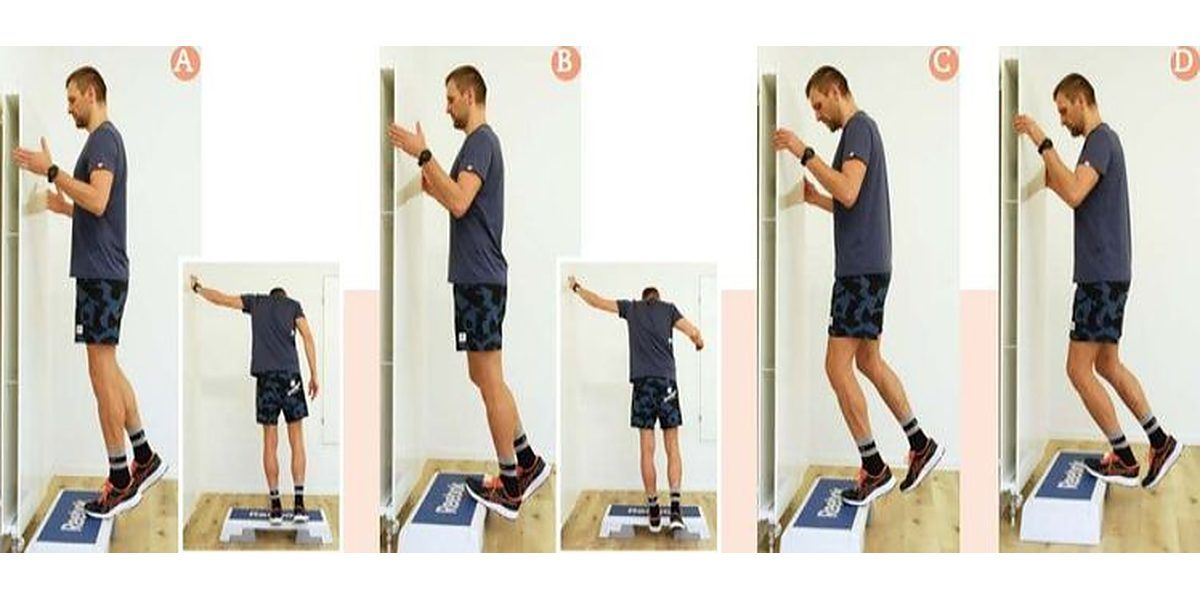
Stand on the ball of one foot on a step or stair. Extend the other leg behind you, with the knee slightly bent (A).
Keep at least one-third of your foot on the step. Flexible shoes generally provide better grip.
As this is a strength exercise, you can and should hold on to a handrail or another fixed support.
Slowly and steadily lower your heel as far as possible. The entire lowering phase should take approximately 4 seconds.
Once you reach the lowest point, pause for about 1 second.
Then raise your heel as high as possible over approximately 2 seconds, pausing at the top for 1 second.
Repeat the exercise by lowering your heel again.
Variation: Instead of keeping the knee straight, perform the exercise with the knee bent (C and D).
Double set: Perform the straight-knee and bent-knee variations in two consecutive sets.
Take note:
Ideally, switch directly from one variation to the other without a break. Keep the heel as straight as possible. Avoid the heel rolling inwards, particularly at the bottom of the movement, or outwards, particularly at the top. Achilles tendon pain during the exercise can reach a level of 5 out of 10. However, it should subside quickly after the exercise.
Repetitions: 3 double sets per leg. Switch legs after each double set. Train 2–3 times per week.
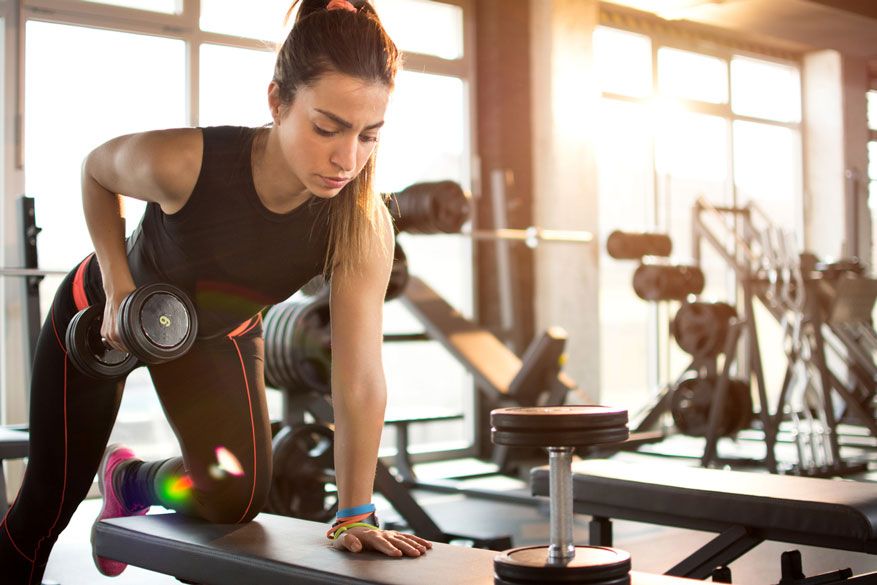
Progression: If body weight alone becomes too easy, hold an additional weight (dumbbell) of around 5–15 kg in one hand.
You might be interested in
Training tips
Why and How You Should Do Strength Training
Until a few years ago, strength training in endurance sports was a voluntary extra session. That has changed. It is increasingly recognized as an indispensable element to be more efficient on the go.
Training tips
What to do when your neck hurts?
Neck pain while cycling is a familiar issue for most and often appears at the beginning of the cycling season or during the first longer rides. Here are three exercises to help strengthen your neck.
Training tips
Combating back pain through leg strength
Runners often suffer from back pain. Surprisingly, strengthening the legs offers more effective pain relief than solely focusing on back exercises, as a study has shown.
General tips
How the condition of your gut affects your performance
An unhealthy gut not only impacts your training but also your recovery, immune system, and motivation. The good news is that you can positively influence your gut health.